Measuring Distance Between Empirical Distributions Using Wasserstein-Based Metrics
[1]:
import torch
import torch.autograd
import torch.nn.functional as F
import numpy as np
import matplotlib.pyplot as plt
import torch.optim as optim
import time
from matplotlib import animation, rc
from IPython.display import HTML
import ot
import ot.plot
Optimize using sliced Wasserstein distance
[12]:
def generateTheta(L,endim):
    # This function generates L random samples from the unit `ndim'-u
    theta=[w/np.sqrt((w**2).sum()) for w in np.random.normal(size=(L,endim))]
    return np.asarray(theta).T
N = 300
d = 2
f = np.random.rand(N, 2) - .5;
theta = 2 * np.pi * np.random.rand(1, N)
r = .99 + .01 * np.random.randn(1, N)
g = np.vstack([np.cos(theta) * r, np.sin(theta) * r]).T

f1 = torch.from_numpy(f.copy())
f1.requires_grad = True
g1 = torch.from_numpy(g)

ims = []
fig, ax = plt.subplots(figsize=(5, 5))
ax.axis('equal')
ax.set_axis_off()
optimizer = optim.Adam([f1], lr=5e-2)
while True:
    ims.append(ax.plot(f1.data.numpy()[:, 0], f1.data.numpy()[:, 1], 'bo',
                  g[:, 0], g[:, 1], 'ro'))
    L=10 # Number of random projections
    theta = torch.from_numpy(generateTheta(L, d))
    projg = torch.mm(g1, theta)
    projg_sorted = torch.topk(projg, k=N, dim=0)[0]
    optimizer.zero_grad()
    projf = torch.mm(f1, theta)
    W2 = (torch.topk(projf, k=N, dim=0)[0] - projg_sorted)**2
    W2 = torch.mean(W2)
    W2.backward()
    optimizer.step()
    if W2.item() < 1e-5:
        break

ani = animation.ArtistAnimation(fig, ims, interval=50, blit=True,
                                repeat_delay=1000)
HTML(ani.to_jshtml())
[12]:
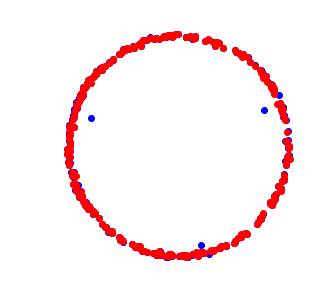
W-2 Wasserstein distance
[13]:
N = 300
d = 2
a, b = np.ones((N,)) / N, np.ones((N,)) / N  # points have equal probability of 1/N
f = np.random.rand(N, 2) - .5;
theta = 2 * np.pi * np.random.rand(1, N)
r = .99 + .01 * np.random.randn(1, N)
g = np.vstack([np.cos(theta) * r, np.sin(theta) * r]).T

f1 = torch.from_numpy(f.copy())
f1.requires_grad = True
g1 = torch.from_numpy(g)

ims = []
fig, ax = plt.subplots(figsize=(5, 5))
ax.axis('equal')
ax.set_axis_off()
optimizer = optim.Adam([f1], lr=5e-2)
while True:
    ims.append(ax.plot(f1.data.numpy()[:, 0], f1.data.numpy()[:, 1], 'bo',
                  g[:, 0], g[:, 1], 'ro'))
    optimizer.zero_grad()
    M = ot.dist(f1.data.numpy(), g, metric='sqeuclidean')
    G = ot.emd(a, b, M)
    ix1, ix2 = np.nonzero(G)
#     W2 = torch.mean(torch.norm(f1 - torch.from_numpy(g[ix2]), p=2, dim=1))
    W2 = torch.mean(torch.sum((f1 - torch.from_numpy(g[ix2]))**2, dim=1))
    W2.backward()
    optimizer.step()
    if W2.item() < 1e-5:
        break

ani = animation.ArtistAnimation(fig, ims, interval=50, blit=True,
                                repeat_delay=1000)
HTML(ani.to_jshtml())
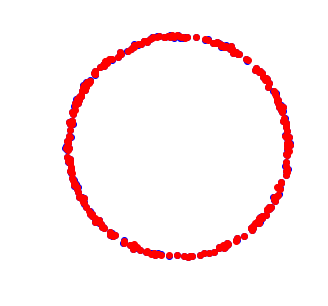
[13]:
[ ]: